Monday, April 25, 2011

Simplified shadow harp

After nearly a week of getting nowhere, we're thrilled to announce that we've (finally) got a working, consistently accurate shadow-type harp! It's much simpler than original designs, using only four LDRs (light dependent resistors) and a modified enclosure.


The original pocket- or shadow- harp designs used a pinhole "lens" to detect the position of the player's hand above the instrument. Even the original instrument's designer, Peter DeSimone, said that his original design was plagued with problems and false-triggers. To solve his false-triggering problems, Peter introduced capacitors and used the LDRs to create an oscillating input (counting the time between pulses to detect the presence - or otherwise - of a shadow).

This seemed like a lot of work for us - the problem is the LDR changes resistance continually, even by small amounts. In theory, a simple voltage divider approach should still work, we just need to eliminate the "false reads" caused by fluctuating analogue inputs.

Using a combination of hardware and software limits and sensitivity settings, we've managed to solve the problems associated with the voltage divider approach and by encasing each LDR inside a black tube, we've also managed to get rid of the cross-talk the plagued other designs.


Our LDR tube sleeves were just drinking straws covered in black crepe paper. There were no black straws in our local Morrisons, so we got these 80s style neon ones and covered them!

We're using just four LDRs and we're treating each as an individual input.
This means that we can trigger four different samples - in software we can decide whether a single sample plays or multiple (polyphonic) sounds can be produced.


Obviously four different notes/chords/samples is a bit limiting, so we're working on a dial that lets the player select a "sample set" during playing - in the same way they can change the key or chord/scale type (e.g. set to C major and the notes could be C, E, G, C, twiddle the dial and the notes could become E,G,A,B from the Em pentatonic scale).

The first thing we need to do is check we've enough spare pins for an LCD display, 4 analogue inputs, 4 LED outputs (an addition that might be useful: an indicator to show that an input has been detected) plus a few extra analogue inputs for the pots/dials. On a beefy 18F4550 that would be a doddle - we've a load of 18F2455 chips lying around from previous projects and it'd be nice to squeeze a bit more use out of those!

Check back for schematics and more videos shortly.......

Sunday, April 24, 2011

Looking for cnc machining services? Take a look at our capabilities here: http://ping.fm/kLKmb
We work for your industry!

Saturday, April 23, 2011

Robo-Roundup #10

http://botropolis.com/wp-content/uploads/b1af_huggable_plush_killer_robots.jpg
This weeks roundup features bots that are small and cute to ones that can't dance. Well, I hope you enjoy this weeks roundup as much as I did!

1. This little bot is practically a money thief: http://spectrum.ieee.org/automaton/robotics/diy/this-begging-robot-can-have-all-my-money

2. This robot may be able to walk, but dancing isn't its natural talent: http://spectrum.ieee.org/automaton/robotics/humanoids/cmus-sarcos-robot-can-mimic-your-terrible-dancing

3. This dexterous robot is able to deftly defuse IEDs: http://robots.net/article/3149.html

4. New and innovative telepresence robot: http://www.roboticstrends.com/service_healthcare/article/gostai_debuts_telepresence_robot

5. The "Bilibot," is to go on sale soon: http://robots.net/article/3155.html

I thank you again for reading this weeks Robo-Roundup, and be sure to check back and read next weeks too! Feel free to comment below!

Friday, April 22, 2011

Introducing the New SimpleBot

The all new SimpleBot from SimpleBotics has features such as ultra-bright LED, pager motor, and a long lasting battery. The robot itself has the pager motor and LED under the battery holder and the legs are located there too. The robots gets power by a small CR2032 cell battery and lets the robot have a "life" span of approx. 1-1 1/2 hours. If you would like to purchase the SimpleBot, then please visit etsy.com, and search The SimpleBot on May 9th, 2011. We thank you so much for considering SimpleBotics, so thanks for reading and what other bots would you like to see us make and sell, just leave your answers in the comment section below!

Tuesday, April 19, 2011

Meet FRIDA, Tomorrows Robotic Factory Worker

http://www.ubergizmo.com/wp-content/uploads/2011/04/frida.jpg
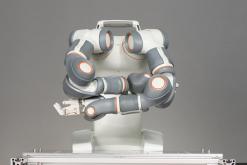
This headless, two armed, dexterous robot may become tomorrows assembly line worker. FRIDA is the robot that has been created by a Swiss company called ABB. Created especially for the assembly line, the robot has the ability to use its pair of dexterous arms to grasp and move electronic gizmos and components. For now the bot is just a concept that ABB designed to show off to people as a new kind of industrial robot, rather than the average car welding robots. This FRIDA robot looks pretty revolutionary when you compare it to the other big and bulky industrial robots that work on the assembly line, and with its new technology and innovations it may just be our next factory worker. Thanks for reading, and how do you think these kinds of robots could impact the modern day industry. Feel free to answer the question below in the comment section!


-original source: http://spectrum.ieee.org/automaton/robotics/industrial-robots/abb-factory-robot-frida


Monday, April 18, 2011

SimpleBotics Shop

Just yesterday I decided to create a website where I would sell our products. So I created a new website called "SimpleBotics Shop" The website is designed to let people buy our robots online with ease. Information such as troubleshooting robots, getting instant info, and much more will be listed on the site. To buy a robot you have to fill out a form and email it to simplebotics@gmail.com then we mail the bot to you. For now no robots are for sale, but we are currently working on making a least five robots to start up with and each costs around $16.99 with batteries included. If you would like to pre-order a robot then feel free to visit the website at www.simpleboticsshop.blogspot.com and fill out the form under the category of "Shop SimpleBotics." Thanks for reading and feel free to comment below!

Sunday, April 17, 2011

Pinhole box to focus light beams

Here's the basic idea - to place a row of LDRs (light dependent resistors) in a row, then place the whole lot inside a box. The inside of the box stays darks, and a small pin-hole is placed in the lid. Each LDR can now receive just a little bit of ambient light, but only from a specific direction. By moving your hand around above the hole, each LDR should be affected but only when your hand covers a narrow region above the box.


By doing this, we should be able to map when the user has placed their hand to a specific sound-trigger. I think this is how the pinhole light harp works. We're working on creating a digital trigger device to begin with, then we'll add an ultrasonic range-finder to calculate how high the player's hand is above the instrument (perhaps to increase volume or play different notes).